
Products Description
Brief Introduction
Loss-in-Weight Feeding System: Introduction and Advantage Analysis
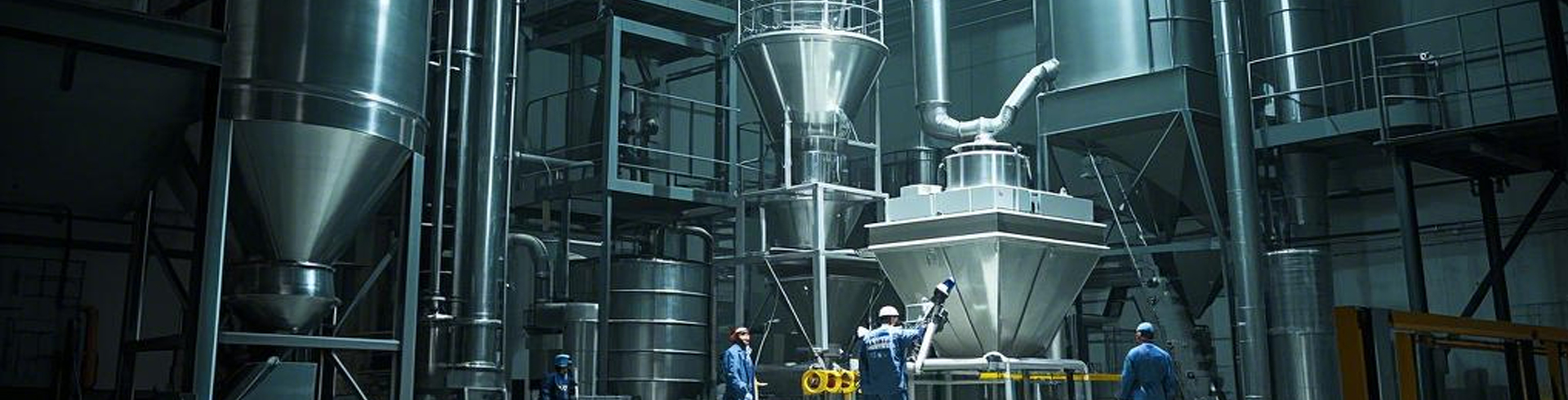
A Loss-in-Weight Feeding System, commonly known as a Loss-in-Weight Feeder or Gravimetric Feeder, is an advanced conveying and dosing system that delivers highly precise, continuous feeding based on the principle of weight reduction.
Core Working Principle:
The system performs real-time, continuous weight monitoring of the entire feed hopper (including the material) and the discharge device (such as a screw feeder, vibratory tray, etc.). The controller calculates the actual discharge rate by measuring the decrease in the total system weight over a specific time interval. This actual rate is continuously compared to a preset target rate, and the speed of the discharge device (e.g., screw rotation or tray vibration) is automatically adjusted to correct any deviation, achieving exceptional accuracy in continuous feeding.
Basic Operating Cycle:
Refill Phase: When the material weight in the hopper drops below a preset lower limit, the system briefly interrupts precise feeding to activate a rapid refill device (e.g., butterfly valve, gate valve) and refill the hopper.
Stable Feeding Phase: After refill, the system resumes the precise Loss-in-Weight control mode, regulating the discharge based on the steady decrease in weight.
Features
The Loss-in-Weight Feeder is the preferred choice for many demanding processes due to its unique and irreplaceable advantages.
1. High Dosing Accuracy and Stability
Direct Weight Measurement: By measuring the material's weight directly, instead of inferring it from volume as volumetric feeders do, its accuracy is largely unaffected by material characteristics (e.g., bulk density changes, flowability, particle size).
Closed-Loop Control: The real-time measurement and feedback control system continuously corrects errors, ensuring long-term, stable high accuracy, typically within ±0.1% to ±0.5%.
2. Superior Versatility and Flexibility
Handles Challenging Materials: Ideal for materials that are prone to bridging, rat-holing, have poor flowability, or are adhesive, as these factors are largely compensated for by the overall weight measurement.
Wide Feeding Range: By changing screw sizes or adjusting speed, the same feeder can handle a broad range of feed rates, from a few kilograms to hundreds of tons per hour.
Multi-Component Handling: A single Loss-in--Weight system can be configured with multiple discharge outlets for precise proportioning and feeding of different materials.
3. Enhanced Production Efficiency and Automation
True Continuous Feeding: Enables uninterrupted material supply, meeting the demands of modern continuous production processes and significantly boosting efficiency.
Seamless System Integration: Easily integrates with plant DCS or PLC control systems for remote monitoring, data logging, and automated production, laying the groundwork for "Industry 4.0" smart factories.
4. Reduced Operating Costs and Material Waste
Minimized Material Loss: High precision means expensive raw materials are not overfed during proportioning, leading to direct cost savings.
Reduced Manual Intervention: Automated operation reduces reliance on operators, lowering labor costs and the risk of human error.
Minimized Downtime: Robust design and stable performance ensure long-term reliability and increase Overall Equipment Effectiveness (OEE).
5. Ease of Cleaning and Maintenance
Modular Design: Many modern Loss-in-Weight Feeders feature a modular design, allowing for quick disassembly, cleaning, and maintenance.
Compliance with Hygiene Standards: Available in hygienic designs that meet GMP and FDA requirements for industries like food and pharmaceuticals, supporting quick clean-down or Clean-in-Place (CIP).
Application Industries
The Loss-in-Weight Feeding System is core equipment in these industries where precise proportioning is critical:
Plastics Industry: Precise dosing of color masterbatch, additives, and the ratio of recycled to virgin material.
Food Industry: Accurate addition of flour, sugar, salt, spices, and other ingredients.
Chemical Industry: Continuous mixing and reactive feeding of various chemicals, powders, and granules.
Building Materials Industry: Precise batching of cement, sand, and additives.
Pharmaceutical Industry: Precision blending of Active Pharmaceutical Ingredients (APIs) and excipients.
Battery Industry: Exact proportioning of cathode/anode powders and conductive agents.
In summary, the Loss-in-Weight Feeding System transcends simple "conveying." It is a high-performance system integrating precision dosing, process control, and continuous conveying. It represents a strategic investment for companies with high standards for product recipe consistency, raw material cost control, and production automation, serving as key equipment for ensuring final product quality and enhancing core competitiveness.